Best AI-Powered SEO Content Tools in 2026: We Tested 9 AI Platforms on the Same SEO Brief
AI SEO content tools all promise faster content production. But speed alone is not the real benchmark.
For agencies, consultants, and in-house SEO teams, the harder question is this:
Can the tool research the market, understand the brand, choose the right page type, map opportunities to existing URLs, write commercially useful content, and reduce manual delivery work?
To find out, we tested 9 SEO content platforms on the same brief:
- Ahrefs Content Helper
- Semrush Content Toolkit
- AirOps
- Jasper
- Writesonic
- Neuron Writer
- Frase
- Sight AI
- ArgSEO
Quick Verdict
In our hands-on test, ArgSEO was the strongest all-round platform for automated SEO content production.
It was the only tool in the test that combined:
- automated keyword and market research
- website crawling
- URL mapping
- commercial page generation
- brand-specific content enrichment
- internal linking
- scheduled content delivery
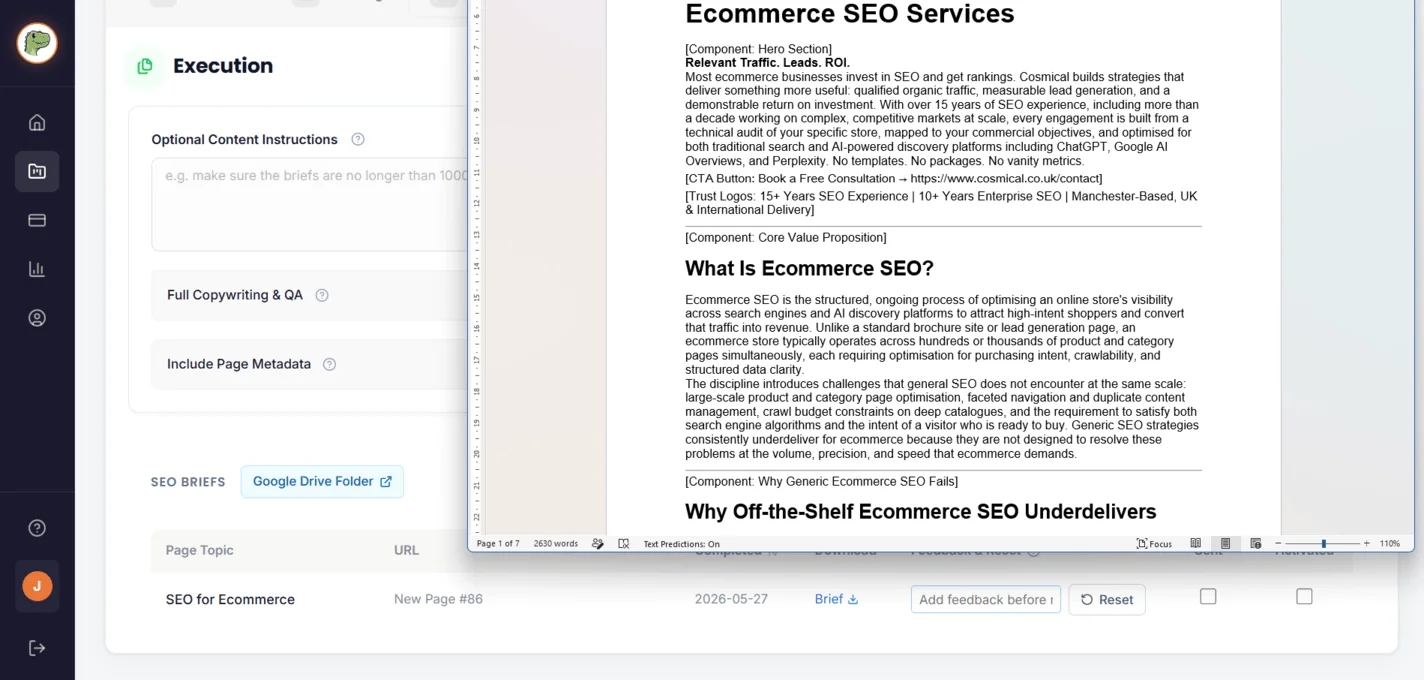
- client-ready Google Doc output
That matters because most SEO content work does not start with writing. It starts with research, prioritisation, page mapping, commercial intent analysis, and briefing.
Most tools we tested generated content. ArgSEO automated more of the actual SEO workflow around the content.
Disclosure
This comparison was conducted by ArgSEO, and ArgSEO is one of the tools included in the test.
That obviously creates a potential conflict of interest. To make the comparison as fair as possible, we used the same target brief, the same test website, and the same scoring framework across the tools where possible.
We also included limitations, competitor strengths, and cases where other tools may be the better choice for specific users.
Key Takeaways
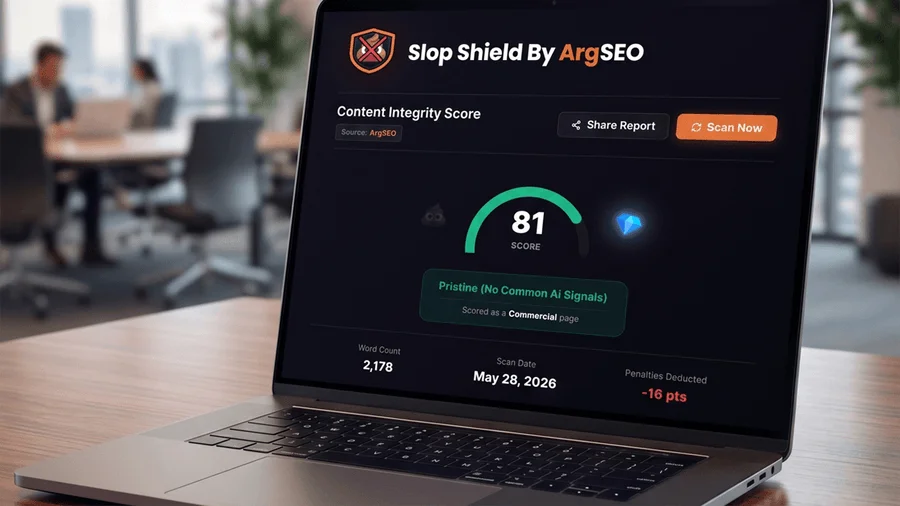
- ArgSEO was the top overall scorer, with an overall Slop Shield score of 81.
- Jasper produced very readable copy, but lacked automated SEO research, URL mapping, and brand-specific context.
- AirOps had one of the strongest workflows, especially because it generates a brief before the article, but it still produced a blog-style result instead of a commercial service page in this test.
- Sight AI was one of the only tools with scheduling, but the setup was manual and the output was more blog-style than commercial.
- Ahrefs and Semrush remain powerful SEO platforms, but their content tools were not full automation systems in this test.
- Most tools struggled with commercial landing pages, often defaulting to informational blog articles even when the brief called for a revenue-focused service page.
- SERP scraping is now table stakes, not a meaningful differentiator by itself.
- The biggest gap in the market is workflow automation, not AI writing speed.
How We Tested the Tools
We used each platform to create content for the same target page:
“Ecommerce SEO Services”
The test website was an older SEO site called Cosmical Marketing.
The intended output was a commercial service landing page, not a blog post. This was deliberate. Commercial pages are where many SEO revenue opportunities sit, and they are harder to produce well than generic informational articles.
We used the features available on each platform’s free, trial, or basic plan where possible.
What We Evaluated
We assessed each tool based on:
- whether it could create a commercial page rather than a blog post
- whether it researched the brand automatically
- whether it performed keyword or topic research
- whether it used live SERP and competitor data
- whether it mapped new opportunities against existing URLs
- whether it included internal links
- whether it produced useful structure such as tables, lists, summaries, and design placeholders
- whether it supported scheduling or true automation
- whether the output was suitable for client or stakeholder review
- the quality of the raw generated content
We then ran each generated page through the Slop Shield Audit Tool.
Slop Shield scores content on a 0 to 100 scale, where higher is better.
Important Limitations
This was a structured hands-on comparison, not a laboratory benchmark.
A few caveats:
- We tested one target page.
- We tested one brand.
- We used free, trial, or basic plan features where available.
- Some tools may perform better on higher-tier plans.
- Some tools may perform better with more manual setup.
- We focused on content generation workflows, not broader SEO features such as backlink analysis, technical audits, rank tracking, or site health monitoring.
- Slop Shield is an ArgSEO tool, so the score should be treated as one structured signal, not the only possible measure of quality.
Overall Scores
Here is the score for the raw output from each platform.
| Tool | Style & Readability | Brand & Value Alignment | Overall Score |
|---|---|---|---|
| ArgSEO | 84 | 78 | 81 |
| Jasper | 93 | 60 | 77 |
| AirOps | 80 | 72 | 76 |
| Writesonic | 97 | 44 | 71 |
| Sight AI | 93 | 44 | 69 |
| Frase | 32 | 88 | 60 |
| Neuron Writer | 0 | 24 | 12 |
| Semrush Content Toolkit | 0 | 24 | 12 |
| Ahrefs Content Helper | N/A | N/A | N/A |
Note: Ahrefs was not scored because its Content Helper did not generate a complete content page in the same way as the other tools.
Feature Comparison
| Tool | Best For | Commercial Page Output | Automated Research | URL Mapping | Scheduler | Brand Context | Overall Verdict |
|---|---|---|---|---|---|---|---|
| ArgSEO | Agencies and SEO teams scaling content | Yes | Yes | Yes | Yes | Deep site crawl | Best full automation workflow |
| AirOps | Custom content workflows | Struggled in this test | Partial | No | No | Brand kit | Strong workflow, but more manual |
| Jasper | Fast marketing copy drafts | Partial | No | No | No | Manual setup | Strong copy assistant, weak SEO automation |
| Writesonic | Quick blog-style content | No in this test | Limited | No | No | Minimal | Fast, but not strategic enough |
| Sight AI | Scheduled content production | No in this test | Partial/manual | Manual sitemap | Yes | Manual setup | Good scheduling, limited automation |
| Frase | Manual SEO content optimisation | No in this test | Partial | Limited | No | Weak in output | Useful research/editor tool |
| Neuron Writer | Manual SERP-led optimisation | Only with manual steering | Partial | No | No | Homepage/manual | Strong SERP guidance, poor output |
| Semrush Content Toolkit | Existing Semrush users | No in this test | Via other Semrush tools | Manual | No | Limited | Useful add-on, not full automation |
| Ahrefs Content Helper | SEO research support | N/A | Strong data | Manual | No | Brand profiles | Helpful for research, not a full writer |
The Biggest Finding: Most AI SEO Tools Still Write Blogs, Not Revenue Pages
The most important pattern in the test was the commercial page gap.
Most platforms were able to create some form of article. But when asked to produce an Ecommerce SEO Services page, many defaulted to a blog-style article such as:
- “What is ecommerce SEO?”
- “How to choose an ecommerce SEO agency”
- “A guide to ecommerce SEO services”
That is not the same as creating a commercial service landing page.
For SEO teams, this matters because commercial pages are often closer to revenue. A tool that can only generate blog posts still leaves a major part of the SEO workflow untouched.
In this test, ArgSEO was the strongest performer for creating a commercial, brand-specific, SEO-focused page without needing the user to manually rebuild the strategy.
Neuron Writer could be steered towards a commercial page, but this required manual override, which reduces its usefulness as an automated content workflow.
Platform Deep Dives
Writesonic
Best for: Fast blog-style drafts when the user already has the strategy, keywords, and editorial direction.
Writesonic offers a quick, accessible experience, but it fell short on strategic depth in this test.
What Worked Well
Writesonic generated readable content quickly. It also offered real-time SERP fetching and competitor insight, which is useful for basic article generation.
The platform can export content in several formats, including HTML, PDF, and DOCX.
Where It Struggled
The site crawl appeared to rely mainly on the homepage, rather than building a deeper understanding of the website or mapping existing URLs.
The tool also required manual keyword and writing style input. Topic suggestions were not available on the free tier, so the strategy still had to come from the user.
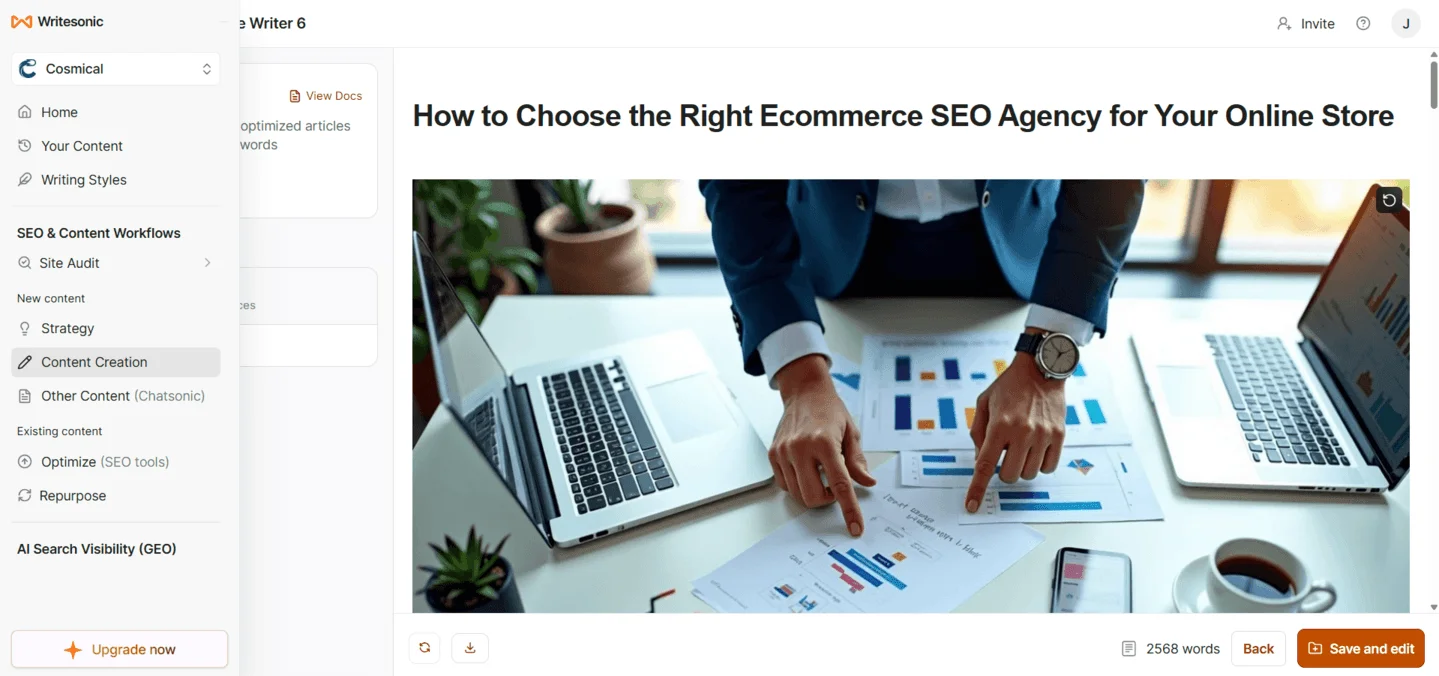
Most importantly, it did not create the requested commercial service page. Instead, it produced a blog-style article titled along the lines of “How to choose the right ecommerce SEO agency for your online store.”
Content Quality Notes
The structure was basic, with subheadings and lists. It did include an AI-generated hero image, but there were no brand mentions and no internal links.
The biggest issue was the external linking. The page included dozens of external links, including links to other SEO agencies. For a commercial service page, that is a serious problem.
Slop Shield Score
- Style & Readability: 97
- Brand & Value Alignment: 44
- Overall Score: 71
Verdict
Writesonic is a solid option for fast, readable blog drafts. It is less suitable for users who need automated commercial SEO pages with brand specificity, internal links, and revenue-focused structure.
Jasper
Best for: Fast marketing copy drafts where the user supplies the research, strategy, and brand context.
Jasper produced one of the more readable outputs in the test, but it relies heavily on the user to provide direction.
What Worked Well
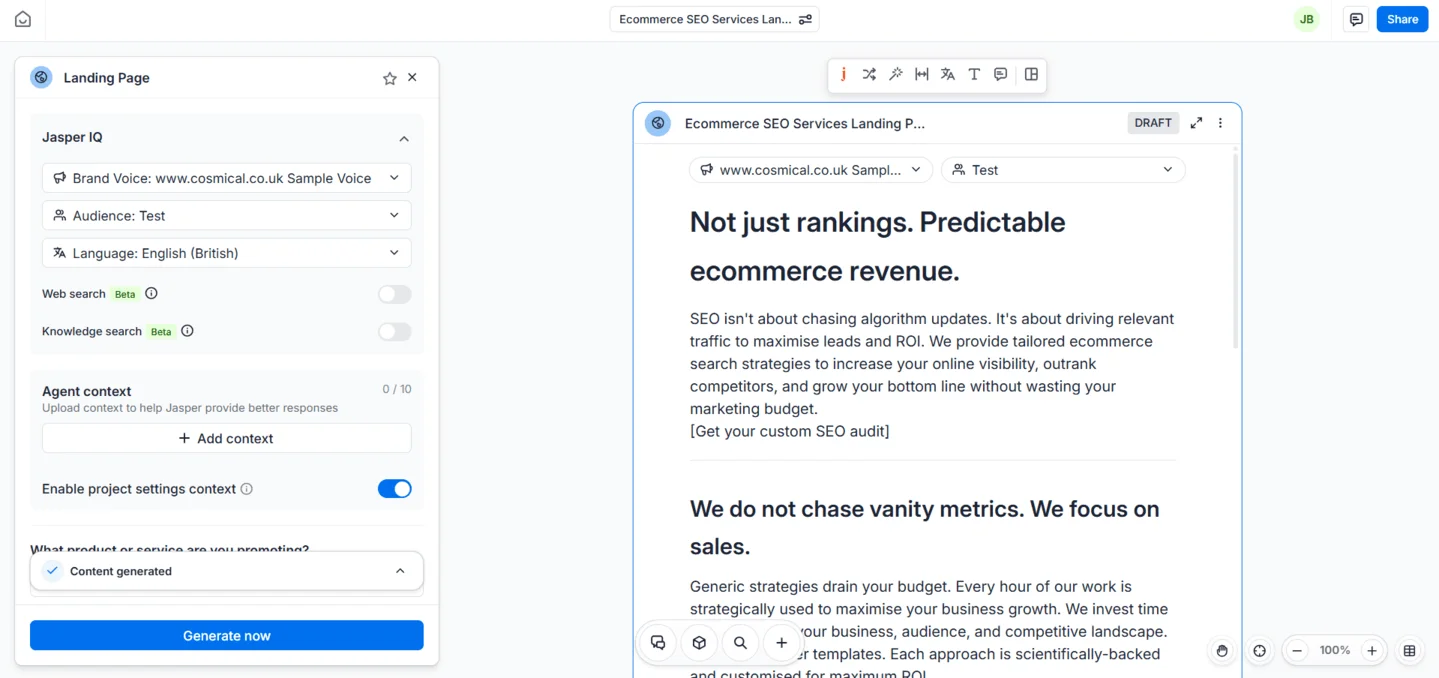
Jasper has a polished interface, generous trial limits, and several pre-built agents for different content types. It can produce clean, readable copy very quickly.
It also supports brand voice features and allows users to upload information about writing style and audience.
Where It Struggled
Jasper did not automatically crawl the website, map URLs, identify content opportunities, or perform keyword research.
Because the tool did not deeply understand the brand or site structure, the content lacked specific brand information and information gain.
Content Quality Notes
The copy was readable, but the structure was basic. It included subheadings, lists, and CTA placeholders, but no internal links and no meaningful brand-specific details.
Unlike Writesonic, Jasper did not add external links. For a commercial page, that is generally a good thing.
Slop Shield Score
- Style & Readability: 93
- Brand & Value Alignment: 60
- Overall Score: 77
Verdict
Jasper is a strong general-purpose AI copy assistant. It is a good fit for teams that already have SEO research and briefs. It is not a complete SEO content automation platform.
Neuron Writer
Best for: Manual SERP-led content optimisation and users who want to steer content creation themselves.
Neuron Writer has useful SEO guidance features, but its automation and raw output were weak in this test.
What Worked Well
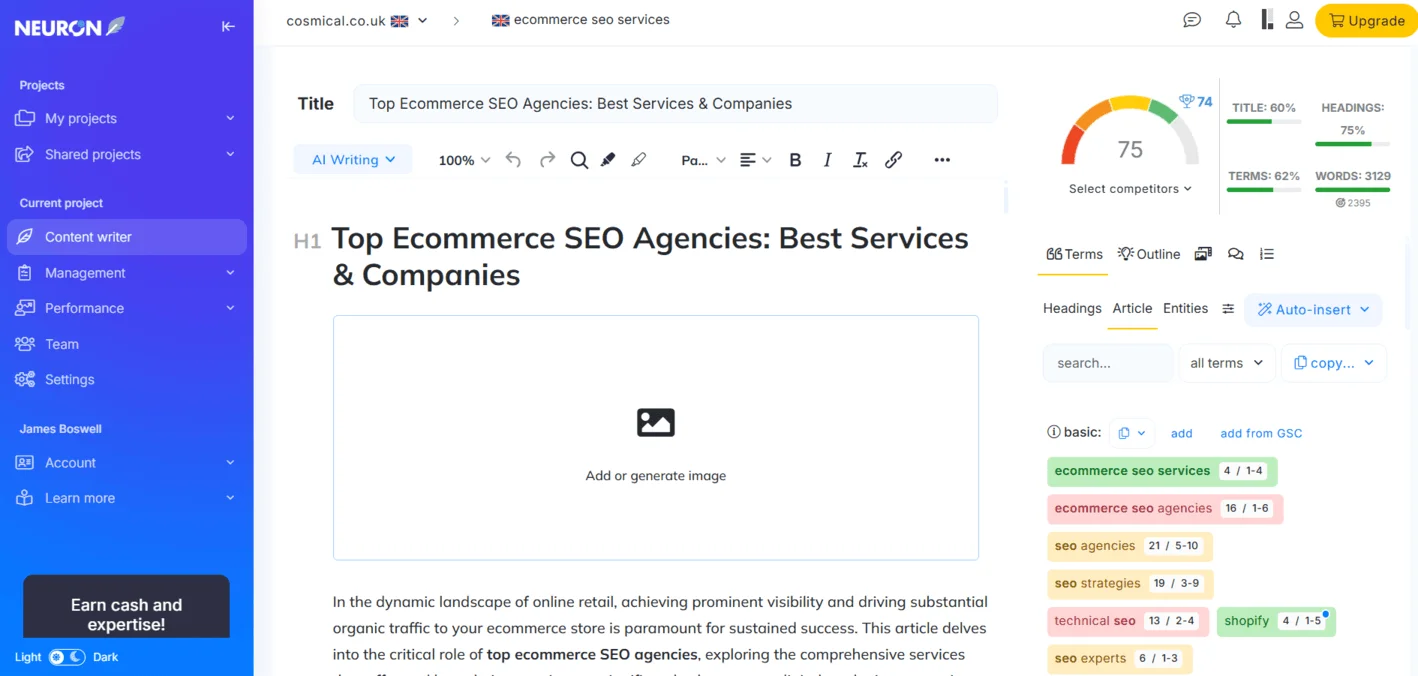
Neuron Writer uses real-time SERP analysis and selected strong competitors for the target query. It also has a Google Search Console connector, which may help users discover opportunities from existing visibility data.
It can scrape the homepage and compile basic brand information, which gives the AI writer some useful context.
Where It Struggled
There was no full site crawl, no automated URL mapping, and no fully automated research workflow for discovering new commercial opportunities.
The tool tended to default towards blog-style content. It could be manually steered towards a commercial page, but that required intervention. For this comparison, that is an important distinction because we were evaluating automation, not just what an expert user can force the tool to do manually.
Content Quality Notes
The structure included subheadings, tables, and image placeholders, but it lacked lists, internal links, and external links.
Brand detail was limited because the automated brand understanding was mostly based on a summarised homepage scrape.
Slop Shield Score
- Style & Readability: 0
- Brand & Value Alignment: 24
- Overall Score: 12
Verdict
Neuron Writer is more useful as a manual SEO content optimisation tool than as a fully automated SEO content platform. It has helpful SERP data, but the raw generated output in this test was not strong.
Frase
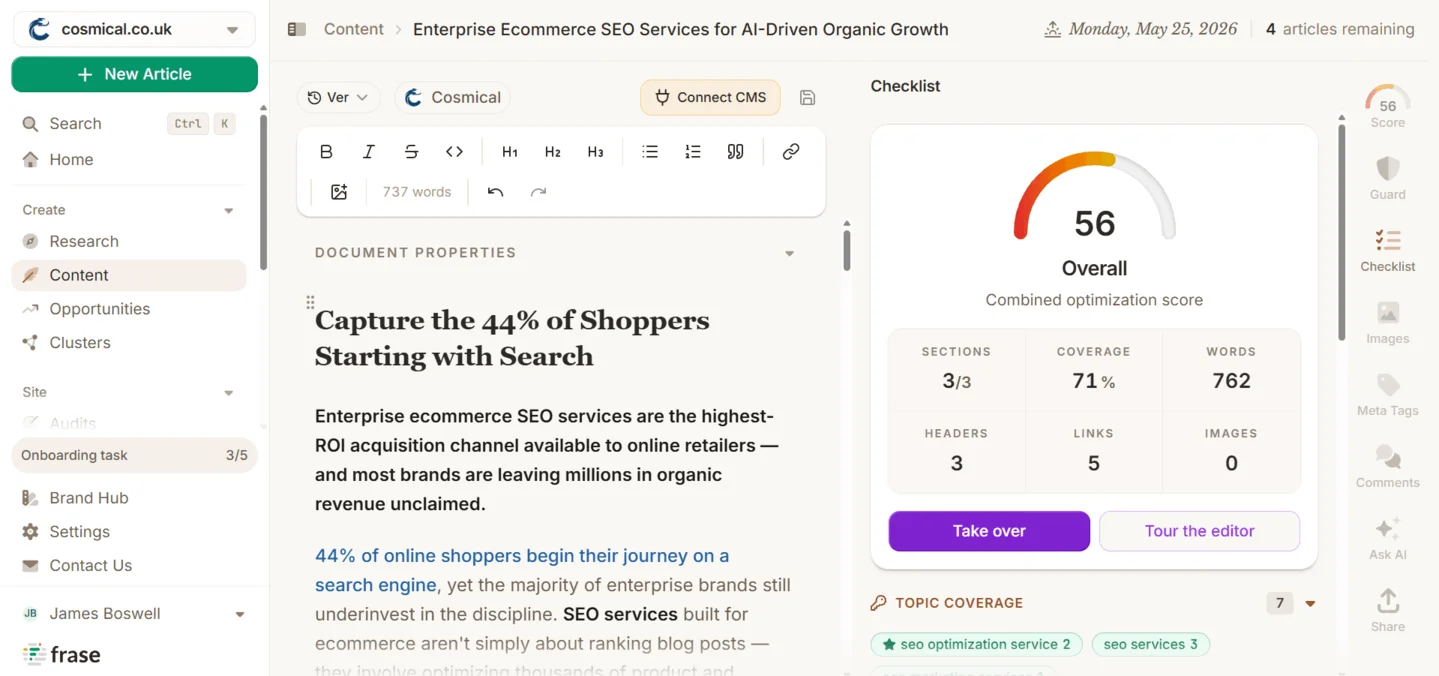
Best for: Users who want SEO research, briefs, and manual content optimisation support.
Frase offers useful research and content planning features, but the output did not match the requested page type in this test.
What Worked Well
Frase crawled the site to understand the brand and identify competitors. It also offered competitor gap analysis and real-time SERP research.
The generated content had more structural variety than many tools, including lists, tables, and call-outs.
Where It Struggled
The automatically identified competitors were not always market-specific or like-for-like. Topic suggestions also leaned heavily towards blog content.
Despite selecting a landing page option, the tool returned a blog-style article rather than a commercial service page.
It also wrote in US English for a British brand, and it was not immediately obvious how to control this from the interface.
Content Quality Notes
The content structure was better than some competitors, but it lacked an inverted pyramid opening, internal links, and brand mentions.
The output also included external links to SEO blogs and one competitor link, which is not ideal for a commercial landing page.
Slop Shield Score
- Style & Readability: 32
- Brand & Value Alignment: 88
- Overall Score: 60
Verdict
Frase is useful for research-led content planning and manual optimisation. It was less effective as an automated commercial page generator in this test.
Sight AI
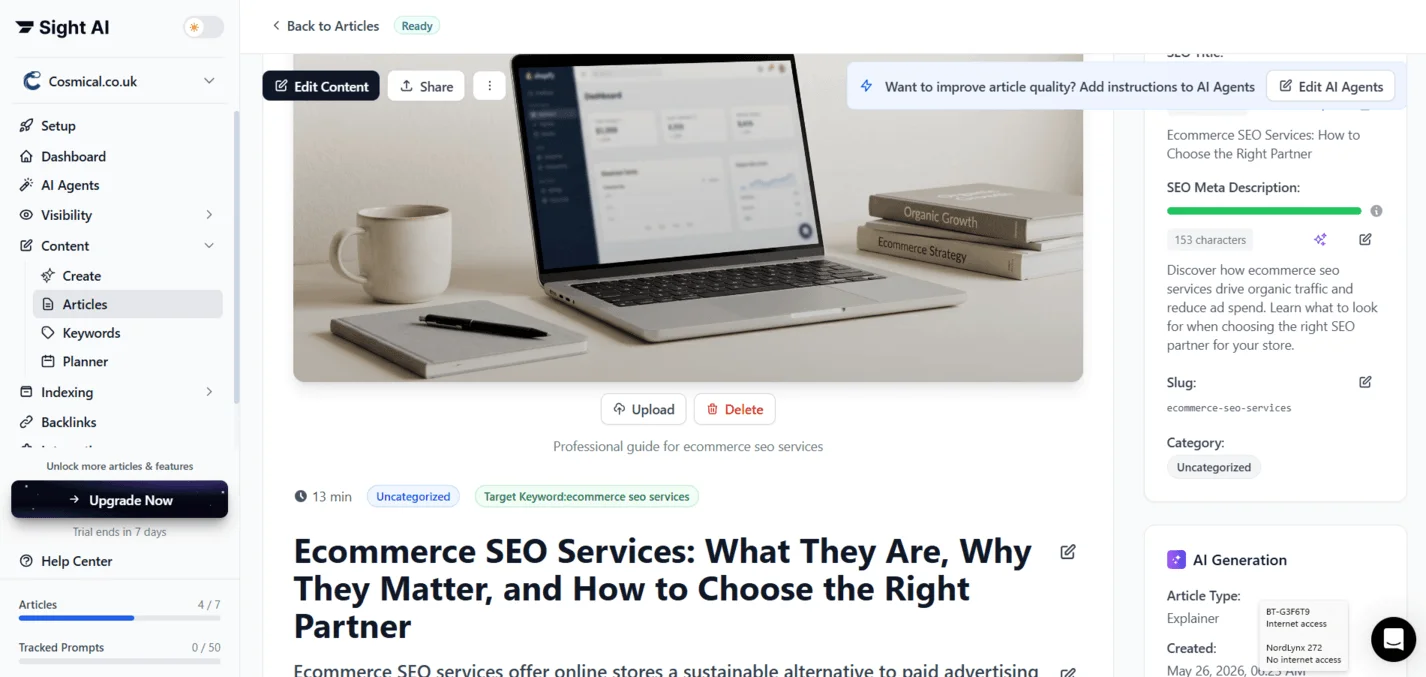
Best for: Users who want scheduled AI content production and are willing to provide brand context manually.
Sight AI was one of the few tools tested that offered scheduling, which makes it more automation-friendly than many competitors.
What Worked Well
During setup, Sight AI lets users add domain information, tone of voice, audience, USPs, competitors, and sitemap data.
This manual setup helped the output include more brand knowledge than tools that made no attempt to understand the business.
It also supports automated scheduling, which was one of the most important workflow features in the test.
Where It Struggled
The setup process was highly manual. The platform did not provide fully automated topic suggestions, keyword research, or competitor discovery.
It also did not automatically account for existing page content.
Content Quality Notes
Sight AI produced a blog-style article rather than the requested commercial landing page. The structure was basic, with subheadings and an automatically generated hero image.
It did include an internal link CTA at the bottom, which suggests that internal linking may be possible if the sitemap is provided manually.
Slop Shield Score
- Style & Readability: 93
- Brand & Value Alignment: 44
- Overall Score: 69
Verdict
Sight AI has promising automation features, especially scheduling. However, it still requires significant manual setup and did not produce the intended commercial page in this test.
AirOps
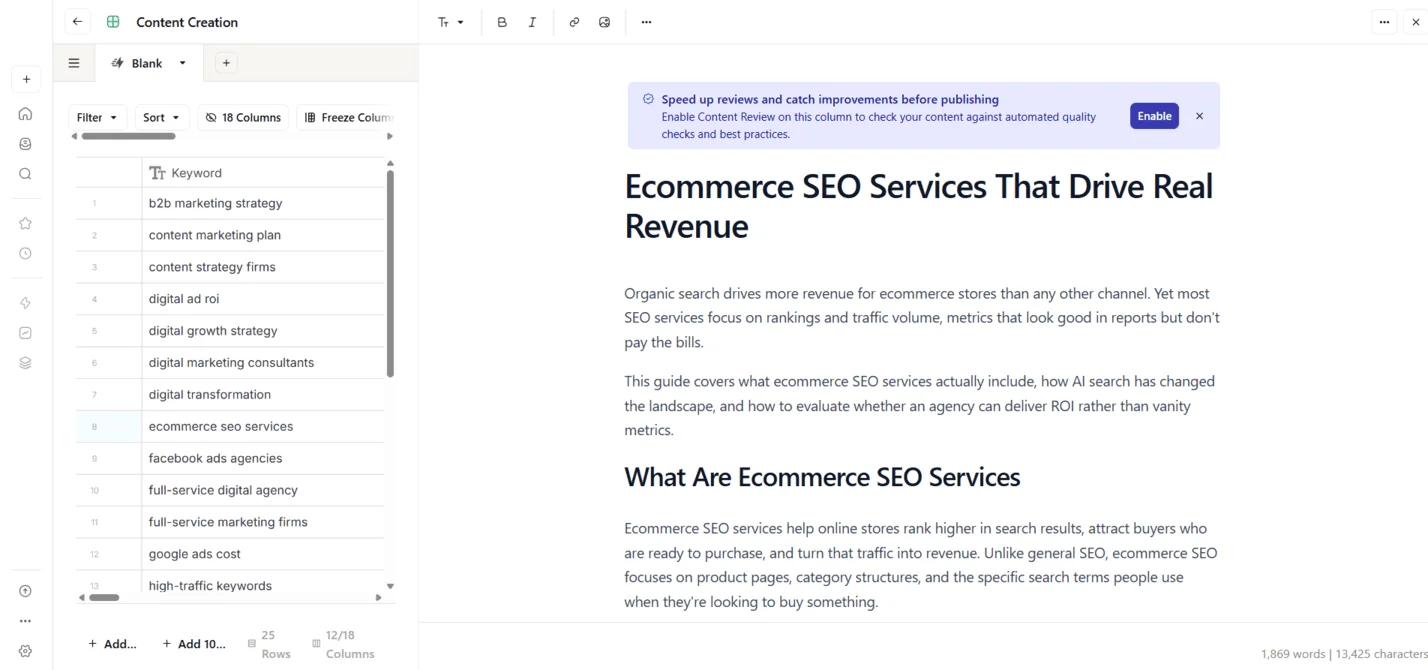
Best for: Teams building custom content workflows and users who want a brief-first process.
AirOps was one of the stronger competitors in the test. Its workflow felt more advanced than most, and it clearly prioritises structured content operations.
What Worked Well
AirOps builds a brand kit from a homepage scrape, allowing the content to include some brand-specific detail.
It also generates a content brief before producing the full copy. This is a good workflow because it gives users a chance to review the strategy before the article is written.
The platform prompts for human review, which is a positive signal for quality control.
The content structure was also strong, including subheadings, lists, tables, internal links, and brand mentions from the brand pack.
Where It Struggled
AirOps does not provide true scheduled content delivery in the same way as ArgSEO or Sight AI. The UI makes it easy to queue multiple pages, but it is still more of a manual generation workflow.
The tool also chose competitors for gap analysis, but the selection was not based on a full live market research process.
Most importantly, it struggled with page type. Instead of creating a commercial ecommerce SEO services page, it produced something closer to a “what is ecommerce SEO” blog article.
Slop Shield Score
- Style & Readability: 80
- Brand & Value Alignment: 72
- Overall Score: 76
Verdict
AirOps is one of the better tools in this comparison. It is well suited to users who want structured workflows and are willing to manually guide the process. It is not as hands-off as a full SEO content automation system.
Semrush Content Toolkit
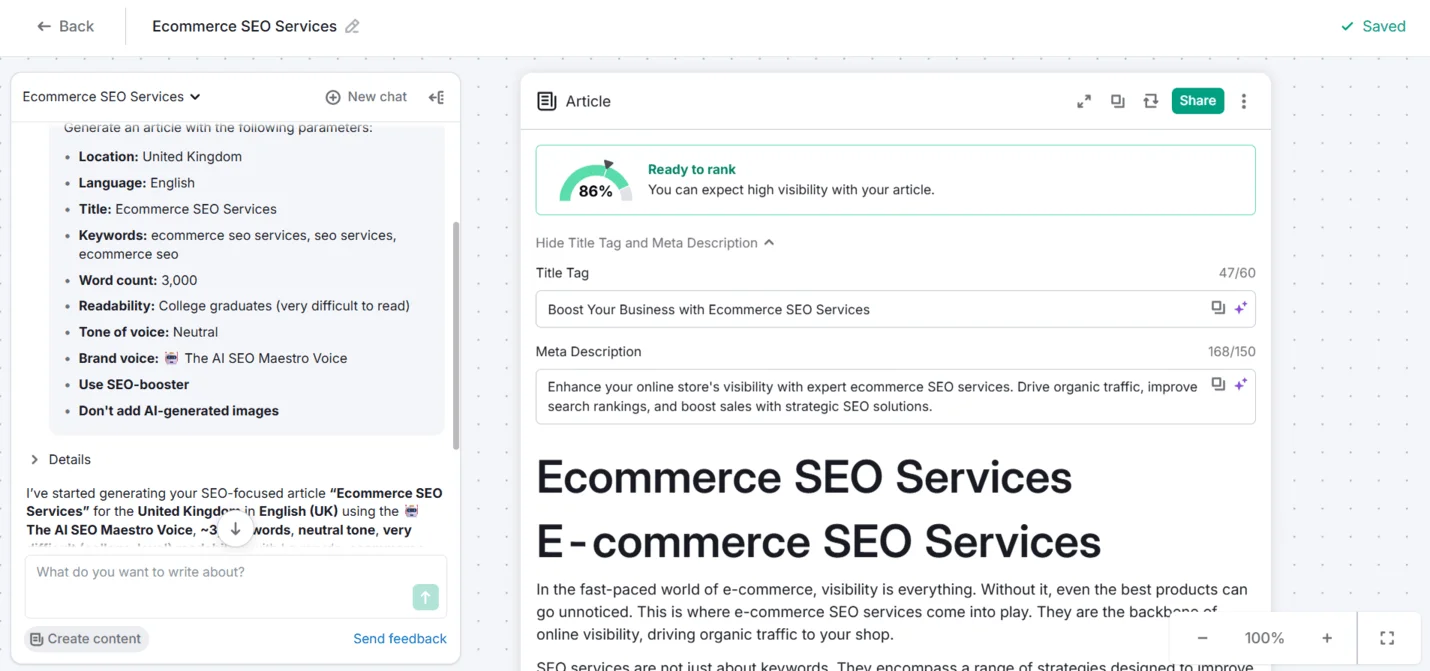
Best for: Existing Semrush users who want content support alongside broader SEO data.
Semrush is a powerful SEO platform overall, but the Content Toolkit was not a complete automation solution in this test.
What Worked Well
Semrush allows users to choose a market and export content to Google Docs. It also has a content brief builder that gives some control over heading structure.
For teams already using Semrush, the wider platform can support keyword research, competitive analysis, and technical SEO work.
Where It Struggled
The Content Toolkit did not automatically research the brand, crawl the site, or map existing URLs. The user has to supply the topic, keyword, and strategic direction.
There was no scheduler, and each page had to be requested manually through the interface.
Despite attempting to steer the tool towards a commercial landing page, the output still resembled a blog article.
Content Quality Notes
The structure was basic, with subheadings and lists, but no tables, design placeholders, or internal links.
Although brand voice settings were available, the final content did not include meaningful brand mentions or information gain.
Slop Shield Score
- Style & Readability: 0
- Brand & Value Alignment: 24
- Overall Score: 12
Verdict
Semrush remains a strong SEO suite, but its Content Toolkit did not behave like a full AI SEO content automation platform in this test. It is better viewed as an add-on for existing Semrush users than a dedicated content automation system.
Ahrefs Content Helper
Best for: SEO professionals who want data, entities, and content guidance rather than fully automated writing.
Ahrefs has excellent SEO data, and that advantage shows in its ability to support research. However, Ahrefs Content Helper did not generate a full page of content in the same way as the other tools.
What Worked Well
Ahrefs was better than many tools at using its data to identify relevant competitors, topics, keywords, and entities.
It also allows users to choose market and build brand profiles, which can help make content less generic.
The tool can identify different search intents and let users choose the direction.
Where It Struggled
Topic selection, URL mapping, and content generation were still highly manual.
The Content Helper provides context that the user can paste into an editor, but it does not write the complete content page as part of the same workflow.
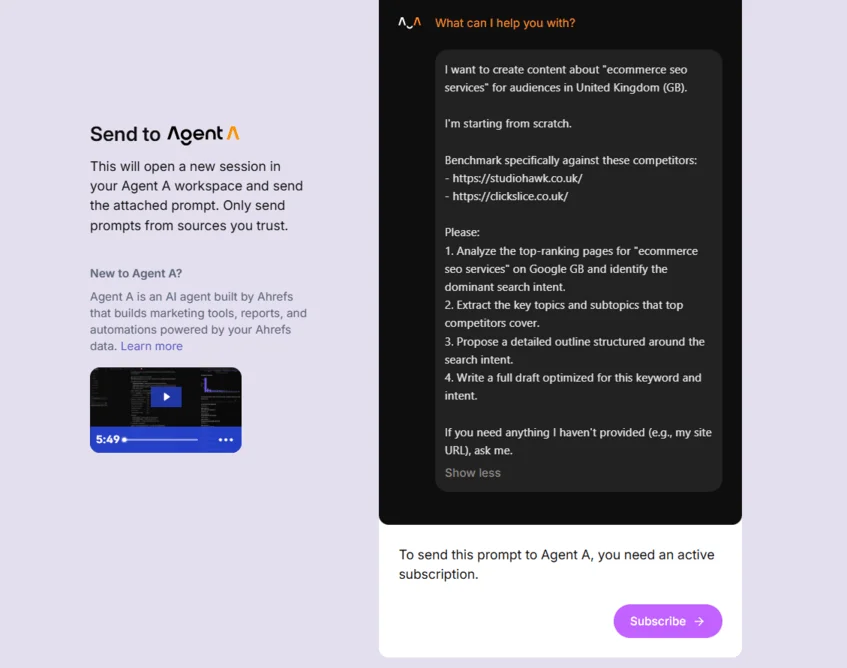
Ahrefs also signposts users towards Agent A. However, in our test, transferring the prompt into Agent A did not appear to create a particularly comprehensive content generation workflow.
Slop Shield Score
Ahrefs was not scored because it did not produce a complete comparable content output.
Verdict
Ahrefs Content Helper is useful for research and content guidance. It is not a like-for-like replacement for an AI content automation platform.
ArgSEO
Best for: Agencies, consultants, and SEO teams that need automated, on-brand, commercially focused content at scale.
ArgSEO was built to automate the work that usually happens before, during, and after SEO content creation.
Most AI content tools start with a topic and generate a document. ArgSEO starts with the website, the market, the competitors, the keywords, the existing URLs, and the commercial opportunity.
That is the main difference.
What Worked Well
ArgSEO crawls up to 200 pages on the target website to build a deeper understanding of the brand, services, messaging, and existing content.
It also performs URL mapping, meaning it can decide whether an opportunity should become a new page or an update to an existing page.
The research process includes:
- keyword research with up to 1,000 keywords
- SERP and ranking analysis
- competitor analysis
- opportunity modelling
- market-share competitor discovery
- page type recommendations
- content instructions
This gives the AI writer much more context than a simple keyword prompt or SERP scrape.
Automation and Workflow
ArgSEO includes a content scheduler, allowing users to plan months of production in advance.
After setup, users can schedule future content batches and receive an email when new work is ready for review.
Outputs can be exported as DOCX and are also saved into a shared Google Drive folder as Google Docs. For agencies, this matters because clients and stakeholders are far more likely to review content in Google Docs than inside a third-party editor.
Content Quality Notes
ArgSEO supports commercial pages, blog content, and custom page types.
It also allows users to define page-type restrictions, such as maximum word counts for specific components.
The generated content used an inverted pyramid structure, front-loading the most important information near the top of the page.
The output included:
- brand mentions
- information gain
- internal links
- tables
- lists
- design placeholders
- commercial messaging
- page-specific structure
ArgSEO also includes human-in-the-loop review stages to help keep the direction accurate before content is finalised.
Slop Shield Score
- Style & Readability: 84
- Brand & Value Alignment: 78
- Overall Score: 81
Verdict
ArgSEO was the strongest all-round performer in this test because it automated more than the writing step.
It handled the research, planning, URL mapping, page type selection, content creation, internal linking, scheduling, and delivery workflow.
For agencies and SEO teams trying to save hundreds of hours across research, briefing, drafting, and client delivery, that workflow difference is the real advantage.
Hidden Friction Points in AI Content Platforms
Our testing revealed several common friction points across AI SEO content tools.
These are not always “dark patterns” in the strictest sense. Some are product limitations, some are pricing choices, and some are workflow assumptions. But they are important for buyers to understand.
1. Fast Generation Can Hide Thin Research
Many tools promote extremely fast article generation.
Fast output is not automatically bad. However, in this test, the quickest workflows often produced more generic content, weaker brand alignment, and less useful structure.
For SEO content, speed is only valuable if the research, page intent, and brand context are still strong.
2. “SEO Writer” Often Means “Blog Writer”
Several tools positioned themselves as SEO content platforms but struggled to create commercial landing pages.
This is a major limitation.
Commercial pages often drive the most valuable organic traffic. If a tool cannot identify and create revenue-focused pages, it only automates part of the SEO content workflow.
3. SERP Scraping Is Not a Differentiator Anymore
Many AI SEO tools scrape top-ranking pages and use them as writing context.
That is useful, but it is no longer a meaningful USP by itself.
The harder work is knowing:
- which pages should exist
- which existing URLs should be updated
- which competitors actually matter
- what the brand can uniquely add
- how the page should support commercial goals
4. In-App Editors Can Create Approval Bottlenecks
Many platforms push users into proprietary in-app editors.
This may work for solo users, but it often breaks down in agency and stakeholder workflows.
In the real world, content usually needs to be reviewed by clients, senior stakeholders, account managers, legal teams, or subject-matter experts. Forcing those people into another app adds friction.
Google Docs, DOCX, and shareable files remain more practical for many professional teams.
5. Per-Project Pricing Can Penalise Agencies
Some platforms limit the number of websites or projects on lower-tier plans.
For agencies, this can become expensive quickly.
Pricing by content generation volume or usage is often more practical than charging heavily for every additional client domain.
6. Manual Brand Context Is Not the Same as Automated Brand Research
Several tools let users manually enter tone of voice, audience, USPs, or competitors.
That is useful, but it is not the same as crawling the website, analysing existing pages, and automatically extracting detailed brand context.
Manual setup still leaves much of the work with the user.
Which Tool Is Right for You?
No single tool is best for every user. The right choice depends on the job you need it to do.
| Use Case | Best Fit | Why |
|---|---|---|
| Full SEO content automation | ArgSEO | Automates research, URL mapping, writing, scheduling, and client-ready delivery |
| Fast general marketing copy | Jasper | Produces readable drafts quickly when the strategy is supplied manually |
| Custom workflow building | AirOps | Strong brief-first process and flexible content workflows |
| Scheduled AI content | Sight AI | One of the few tools with future scheduling |
| Manual SEO briefs and optimisation | Frase or Neuron Writer | Useful for SERP-led research and content guidance |
| SEO data-led research | Ahrefs or Semrush | Strong broader SEO datasets, but not full content automation in this test |
| Quick blog drafts | Writesonic | Fast output for users who already know the topic and keyword |
Why ArgSEO Scored Highest
ArgSEO did not win simply because it generated the best individual draft.
It won because it automated the surrounding SEO workflow.
Most tools ask the user to bring:
- the topic
- the keyword
- the competitor list
- the page type
- the URL decision
- the brand context
- the internal links
- the brief
- the schedule
- the review process
ArgSEO is designed to handle far more of that work automatically.
It takes longer to produce the first article because it is doing the research required to make the automation useful:
- crawling up to 200 pages
- mapping existing URLs
- analysing keyword opportunities
- reviewing SERPs
- identifying competitors
- modelling content opportunities
- building a roadmap
- preparing client-ready deliverables
Once that foundation is built, users can schedule dozens or hundreds of opportunities into future production.
That is why the core benefit is not just better content.
It is time saved across research, planning, briefing, writing, formatting, internal linking, file management, and client delivery.
Final Verdict
The AI SEO content market is crowded, but many tools still solve only one part of the problem.
They generate drafts.
That can be useful, but professional SEO content production requires much more than draft generation.
You need research, prioritisation, brand understanding, URL mapping, commercial intent, structure, internal links, review workflows, and delivery systems.
In this test, ArgSEO was the strongest fit for agencies and SEO teams that want to automate high-quality, on-brand, commercially focused SEO content at scale.
Other tools still have valid use cases:
- Jasper is strong for fast copy drafts.
- AirOps is strong for custom workflows.
- Frase and Neuron Writer are useful for manual optimisation.
- Ahrefs and Semrush remain valuable for SEO research.
- Sight AI offers useful scheduling.
- Writesonic can help with quick blog-style drafts.
But if the goal is to replace the manual SEO content workflow rather than simply generate another article, ArgSEO was the clear winner in our test.
Need Help With Content That Drives Revenue?
ArgSEO researches your market, maps your URLs, finds content opportunities, and creates client-ready SEO content designed to save hundreds of hours every month.
Get Started →